
Last names can tell fascinating stories about family roots, cultural traditions, and personal identity. Some are familiar and timeless, while others sound bold, elegant, or wonderfully unusual. Whether you’re researching your ancestry or naming a character, finding the right surname can make your search more interesting.
This guide brings together last names from different countries, historical backgrounds, and naming traditions. You’ll find popular American surnames, distinctive European family names, and options inspired by nature, animals, royalty, and occupations. We’ve also included cool, strong, and rare surnames for fictional characters, gaming profiles, and creative projects.
Beyond the lists, you’ll learn how surnames developed, what influences their meanings, and why spelling conventions differ across cultures. Use these collections for inspiration, or start tracing the story behind your own family name. There’s plenty to explore, whether you prefer something traditional or completely unexpected.
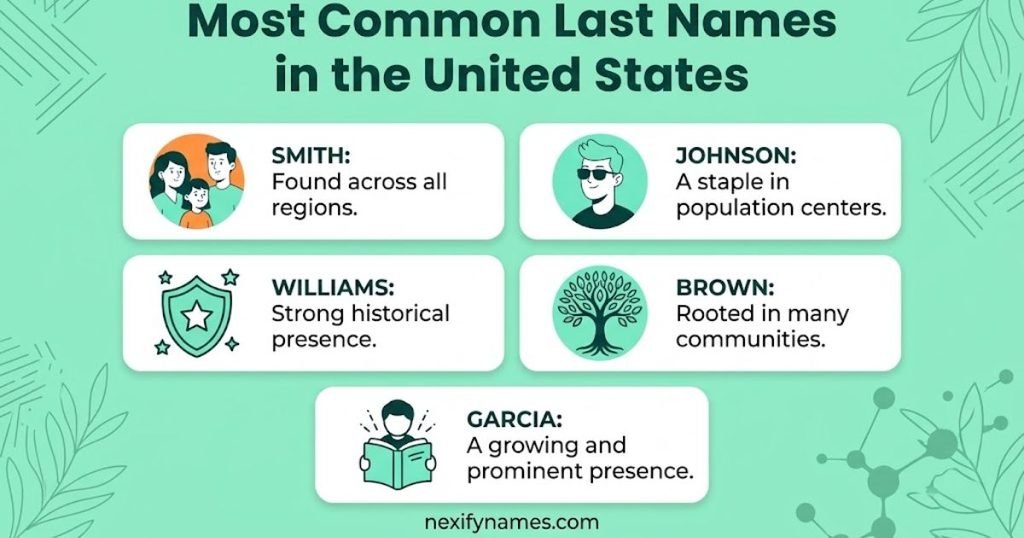
Most Common Last Names in the United States
American surnames reflect centuries of immigration, family history, and cultural exchange. Names such as Smith, Johnson, and Williams remain widely recognized, while surnames like Garcia and Rodriguez reflect the country’s large Spanish-speaking population. Rankings can vary depending on the data source and census year.
- Smith
- Johnson
- Williams
- Brown
- Jones
- Garcia
- Miller
- Davis
- Rodriguez
- Wilson
- Martinez
- Anderson
- Taylor
- Thomas
- Hernandez
Most Common English Last Names
English surnames often developed from occupations, places, personal characteristics, or an ancestor’s given name. For example, Taylor originally referred to someone who made clothes, while Hill could identify someone who lived near a hill. Many of these names spread worldwide through migration.
- Smith
- Taylor
- Williams
- Brown
- Jones
- Davies
- Wilson
- Evans
- Thomas
- Roberts
- Walker
- Wright
- Thompson
- White
- Robinson
Most Common American Last Names
American last names come from many linguistic and cultural traditions. Some originated in Britain and Ireland, while others arrived through Spanish, German, French, Asian, and other naming traditions. The following surnames are familiar choices for characters, family-history research, or general name inspiration.
- Miller
- Moore
- Jackson
- Martin
- Lee
- Perez
- Thompson
- White
- Harris
- Clark
- Lewis
- Young
- Hall
- Allen
- King
Most Common British Last Names
British surnames reflect the histories of England, Scotland, Wales, and Northern Ireland. Some have occupational roots, while others developed from locations or ancestral names. A surname’s popularity can differ considerably between regions, making local records especially useful for genealogy.
- Smith
- Jones
- Taylor
- Brown
- Williams
- Wilson
- Johnson
- Davies
- Robinson
- Wright
- Thompson
- Evans
- Walker
- White
- Hughes
Most Common Irish Last Names
Irish surnames often preserve links to Gaelic family lineages and historic clans. Prefixes such as O’ and Mc or Mac can indicate descent from an ancestor, although their meanings and historical use vary. These surnames are found throughout Ireland and in Irish communities worldwide.
- Murphy
- Kelly
- Byrne
- Ryan
- O’Sullivan
- Walsh
- O’Brien
- McCarthy
- O’Connor
- Doyle
- Kennedy
- Gallagher
- O’Neill
- Lynch
- Murray
Most Common Scottish Last Names
Scottish surnames may connect families to clans, ancestral given names, occupations, or geographic locations. Names such as Campbell and Stewart have strong historical associations, while MacDonald reflects a traditional Gaelic naming pattern. Not everyone with the same surname necessarily belongs to the same family branch.
- Campbell
- Stewart
- Robertson
- Thompson
- Anderson
- MacDonald
- Scott
- Murray
- Reid
- Ross
- Wilson
- Fraser
- Hamilton
- Graham
- Douglas
Most Common Welsh Last Names
Welsh surnames frequently developed from patronymic naming traditions, in which a person’s name reflected their father’s name. Names such as Evans, Davies, and Morgan remain closely associated with Wales. However, these surnames are also common in other parts of Britain and beyond.
- Jones
- Davies
- Williams
- Evans
- Thomas
- Roberts
- Lewis
- Hughes
- Morgan
- Griffiths
- Price
- Edwards
- Owen
- Rees
- Pritchard
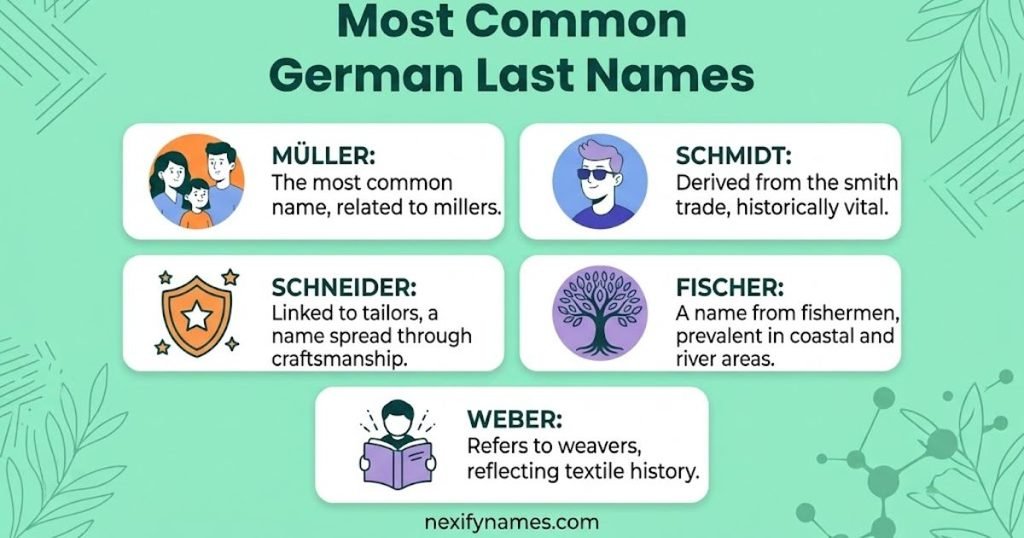
Most Common German Last Names
German surnames often originated from jobs, personal descriptions, or places where families lived. Müller, commonly written as Mueller when umlauts aren’t available, refers to a miller. Regional spelling differences and migration have created several variations of German family names.
- Müller
- Schmidt
- Schneider
- Fischer
- Weber
- Meyer
- Wagner
- Becker
- Schulz
- Hoffmann
- Schäfer
- Koch
- Bauer
- Richter
- Klein
Most Common French Last Names
French surnames developed from occupations, geographic features, personal names, and descriptions. Martin is a particularly widespread surname in France, while names such as Dubois and Lefebvre preserve clues about historical language and everyday life. French surnames also appear throughout Canada and other French-speaking communities.
- Martin
- Bernard
- Thomas
- Petit
- Robert
- Richard
- Durand
- Dubois
- Moreau
- Laurent
- Simon
- Michel
- Lefebvre
- Leroy
- Roux
Most Common Italian Last Names
Italian surnames often have regional variations and roots in occupations, places, nicknames, or given names. Some end in vowels, reflecting common patterns in Italian words. Others, including names beginning with De or Di, may preserve links to an ancestor or family relationship.
- Rossi
- Russo
- Ferrari
- Esposito
- Bianchi
- Romano
- Colombo
- Ricci
- Marino
- Greco
- Bruno
- Gallo
- Conti
- De Luca
- Costa
Most Common Spanish Last Names
Spanish surnames frequently include patronymic forms ending in -ez, historically associated with descent or family relationships. García, Rodríguez, and Fernández are familiar examples. Naming customs differ across Spanish-speaking countries, and many people traditionally use both paternal and maternal surnames.
- García
- Rodríguez
- González
- Fernández
- López
- Martínez
- Sánchez
- Pérez
- Gómez
- Martín
- Jiménez
- Ruiz
- Hernández
- Díaz
- Álvarez
Most Common Mexican Last Names
Mexican surnames reflect Spanish colonial history, Indigenous heritage, and generations of cultural blending. Many families use two surnames, commonly inherited from their father’s and mother’s sides. The order and legal conventions can depend on the country and the family’s circumstances.
- Hernández
- García
- Martínez
- López
- González
- Pérez
- Rodríguez
- Sánchez
- Ramírez
- Cruz
- Flores
- Gómez
- Morales
- Vázquez
- Reyes
Most Common Portuguese Last Names
Portuguese surnames appear in Portugal, Brazil, and communities around the world. Many developed from occupations, locations, religious traditions, or family relationships. Names such as Silva and Costa are especially recognizable, although surname frequency varies between Portuguese-speaking countries.
- Silva
- Santos
- Ferreira
- Pereira
- Costa
- Oliveira
- Rodrigues
- Martins
- Sousa
- Fernandes
- Gonçalves
- Gomes
- Lopes
- Ribeiro
- Carvalho
Most Common Dutch Last Names
Dutch surnames may describe a person’s occupation, ancestral relationship, or place of residence. Some include prefixes such as van, meaning “from,” or de, meaning “the.” These prefixes don’t automatically indicate nobility; their significance depends on each surname’s history.
- de Jong
- Jansen
- de Vries
- van den Berg
- van Dijk
- Bakker
- Janssen
- Visser
- Smit
- Meijer
- de Boer
- Mulder
- de Groot
- Bos
- Vos
Most Common Scandinavian Last Names
Scandinavian surnames come from Denmark, Norway, Sweden, and nearby Nordic traditions. Many historically used patronymics, such as names ending in -son or -sen, to identify someone’s family relationship. Others refer to landscapes, farms, or local geographic features.
- Andersson
- Johansson
- Karlsson
- Nilsson
- Eriksson
- Larsson
- Olsson
- Persson
- Hansen
- Nielsen
- Jensen
- Pedersen
- Larsen
- Berg
- Dahl
Most Common Russian Last Names
Russian surnames often include endings that differ by gender. For instance, a family name may have a masculine form ending in -ov and a feminine form ending in -ova. Not every Russian surname follows this pattern, and spelling can change when names are transliterated into English.
- Ivanov
- Smirnov
- Kuznetsov
- Popov
- Sokolov
- Lebedev
- Kozlov
- Novikov
- Morozov
- Petrov
- Volkov
- Solovyov
- Vasiliev
- Zaytsev
- Pavlov
Most Common Ukrainian Last Names
Ukrainian surnames preserve regional history, family relationships, and linguistic traditions. Common endings include -enko, -uk, and -chuk, although these patterns aren’t exclusive to Ukraine. English spellings can vary depending on the transliteration system used.
- Shevchenko
- Kovalenko
- Bondarenko
- Boyko
- Tkachenko
- Kovalchuk
- Kravchenko
- Oliynyk
- Melnyk
- Petrenko
- Polishchuk
- Marchenko
- Tkachuk
- Savchenko
- Romanenko
Most Common Polish Last Names
Polish surnames can reflect occupations, geographic origins, family relationships, and historical social structures. Names ending in -ski or -cki are widely recognized, but these endings don’t guarantee noble ancestry. Polish spelling also uses distinctive characters that may be simplified abroad.
- Nowak
- Kowalski
- Wiśniewski
- Wójcik
- Kowalczyk
- Kamiński
- Lewandowski
- Zieliński
- Szymański
- Woźniak
- Dąbrowski
- Kozłowski
- Jankowski
- Mazur
- Krawczyk
Most Common Greek Last Names
Greek surnames may reveal family relationships, occupations, geographic origins, or connections to given names. Some endings are associated with particular regions, including Crete and the Greek islands. Transliteration into English can produce different spellings of the same Greek name.
- Papadopoulos
- Papadakis
- Georgiou
- Dimitriou
- Nikolaidis
- Ioannidis
- Pappas
- Vasileiou
- Antoniou
- Christodoulou
- Karagiannis
- Angelopoulos
- Theodorou
- Stavros
- Makris
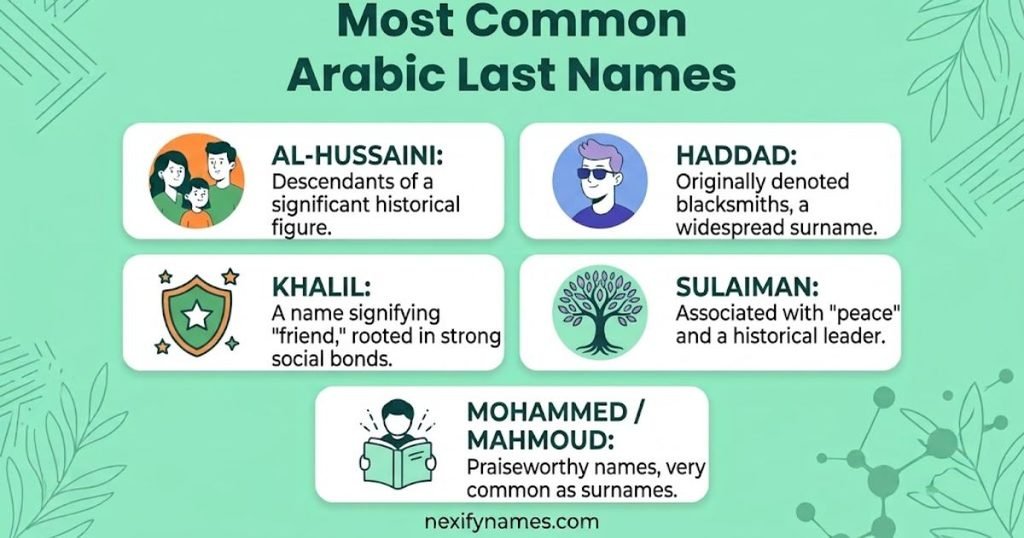
Most Common Arabic Last Names
Arabic surnames are used across many countries, so their meanings and prevalence differ by region. Some refer to ancestry or tribal affiliation, while others reflect occupations, places, or personal characteristics. A surname’s spelling may also vary when written in Latin characters.
- Hassan
- Hussein
- Ali
- Ahmed
- Mahmoud
- Mansour
- Khalil
- Rahman
- Farouk
- Nasser
- Saleh
- Hamdan
- Haddad
- Najjar
- Darwish
Most Common Turkish Last Names
Modern Turkish surnames include many words related to nature, character, family history, and everyday life. Turkey’s Surname Law of 1934 helped establish hereditary family surnames as part of modern civil identity. The examples below include widely recognized Turkish family names.
- Yılmaz
- Kaya
- Demir
- Şahin
- Çelik
- Yıldız
- Yıldırım
- Öztürk
- Aydın
- Özdemir
- Arslan
- Doğan
- Kılıç
- Aslan
- Koç
Most Common Indian Last Names
India has many languages, religions, and regional naming customs, so no single surname list represents the entire country. Family names may reflect ancestry, occupations, communities, places, or traditional social identities. Their meanings and use can vary significantly across regions.
- Sharma
- Patel
- Singh
- Gupta
- Verma
- Kumar
- Mehta
- Reddy
- Iyer
- Nair
- Chatterjee
- Mukherjee
- Desai
- Kapoor
- Malhotra
Most Common Pakistani Last Names
Pakistani surnames reflect the country’s diverse languages, regional identities, and family traditions. Some people use hereditary surnames, while others commonly use a father’s name, clan affiliation, title, or additional family identifier. Practices differ across Punjabi, Sindhi, Pashtun, Baloch, and other communities.
- Khan
- Malik
- Ahmed
- Ali
- Hussain
- Sheikh
- Chaudhry
- Butt
- Qureshi
- Siddiqui
- Shah
- Abbasi
- Jutt
- Bajwa
- Mirza
Most Common Chinese Last Names
Chinese surnames generally come before given names in traditional Chinese name order. A relatively small group of surnames is shared by a large part of the population. Romanized spellings can differ depending on dialect, language, and transliteration method.
- Wang
- Li
- Zhang
- Liu
- Chen
- Yang
- Huang
- Zhao
- Wu
- Zhou
- Xu
- Sun
- Ma
- Zhu
- Hu
Most Common Japanese Last Names
Japanese surnames frequently refer to geographic features, settlements, or landscapes. Names such as Tanaka and Yamamoto have meanings connected to fields and mountains, although interpretations depend on the kanji used. The same pronunciation may represent different written names.
- Sato
- Suzuki
- Takahashi
- Tanaka
- Watanabe
- Ito
- Yamamoto
- Nakamura
- Kobayashi
- Kato
- Yoshida
- Yamada
- Sasaki
- Yamaguchi
- Matsumoto
Most Common Korean Last Names
Korean surnames are often short, and a small number of family names account for a substantial share of the population. Kim, Lee, and Park are especially well known. Different families sharing a surname may belong to different ancestral clans, traditionally identified through their bon-gwan.
- Kim
- Lee
- Park
- Choi
- Jung
- Kang
- Cho
- Yoon
- Jang
- Lim
- Han
- Shin
- Seo
- Kwon
- Hwang
Most Common Vietnamese Last Names
Vietnamese surnames often appear before middle and given names. Nguyen is particularly widespread, reflecting historical naming patterns and political history. Many Vietnamese surnames are shared by unrelated families, so a surname alone doesn’t establish a close family connection.
- Nguyen
- Tran
- Le
- Pham
- Hoang
- Huynh
- Phan
- Vu
- Vo
- Dang
- Bui
- Do
- Ho
- Ngo
- Duong
Most Common Filipino Last Names
Filipino surnames reflect Indigenous heritage, Spanish colonial history, and influences from other cultures. Many families have Spanish-derived surnames, although sharing one doesn’t necessarily mean a family has Spanish ancestry. Local languages and regional history also contribute to the country’s naming traditions.
- Santos
- Reyes
- Cruz
- Bautista
- Ocampo
- Garcia
- Mendoza
- Torres
- Flores
- Gonzales
- Ramos
- Castillo
- Rivera
- Aquino
- Dela Cruz
Common Jewish Last Names
Jewish surnames developed across many countries and languages, including Hebrew, Yiddish, German, Spanish, and Slavic traditions. Some reflect occupations or locations, while others connect to ancestral names. A surname alone cannot reliably establish someone’s religion, ethnicity, or Jewish ancestry.
- Cohen
- Levy
- Goldberg
- Friedman
- Rosenberg
- Kaplan
- Shapiro
- Weiss
- Katz
- Greenberg
- Stern
- Feldman
- Rubin
- Adler
- Bernstein
Common Biblical Last Names
Biblical surnames can draw inspiration from people, places, and family names associated with the Bible. Some are hereditary surnames today, while others began as given names or religious references. They’re popular choices for historical fiction, faith-inspired characters, and genealogy research.
- Abraham
- Benjamin
- David
- Solomon
- Moses
- Jacob
- Isaac
- Joseph
- Samuel
- Aaron
- Daniel
- Simon
- Thomas
- Matthew
- Lazarus
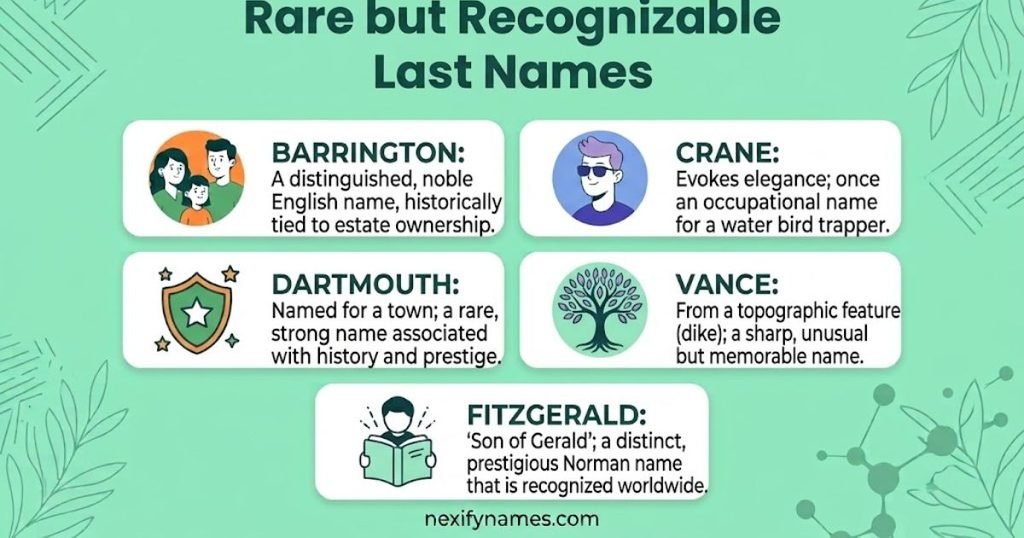
Rare but Recognizable Last Names
Rare surnames can help a fictional character feel distinctive without sounding completely unfamiliar. Some are uncommon because they have limited regional use, while others have become less frequent over time. Actual rarity depends on the country and the available population records.
- Ainsworth
- Bellamy
- Calder
- Ellington
- Fairchild
- Hawthorne
- Winslow
- Whitlock
- Ashbourne
- Merriweather
- Lockwood
- Pembroke
- Everhart
- Kingsley
- Waverly
Short Last Names
Short surnames are easy to read, remember, and pair with longer first names. They’re also useful for usernames, character profiles, and pen names where space matters. A short surname can sound gentle, sharp, modern, or traditional depending on its pronunciation.
- Lee
- Wu
- Ng
- Fox
- Reed
- King
- Cole
- Shaw
- West
- Day
- Ray
- Hunt
- Wood
- Snow
- Nash
Long Last Names
Long surnames can bring personality and a sense of history to a name. They’re especially useful for aristocratic characters, elaborate fantasy worlds, and stories set in cultures with longer naming conventions. When choosing one, consider how easily readers can pronounce and remember it.
- Abercrombie
- Featherstone
- Montgomery
- Weatherington
- Worthington
- Fitzwilliam
- Huntington
- Kensington
- Ravenscroft
- Pemberton
- Butterworth
- Chamberlain
- Harrington
- Vandermeer
- Winterbourne
Cool Last Names
Cool surnames often have a memorable sound, a strong rhythm, or an unexpected meaning. They can suit fictional heroes, online gaming identities, creative profiles, and modern characters. Choose one that fits the personality you’re building rather than relying on style alone.
- Archer
- Blaze
- Cross
- Drake
- Falcon
- Hunter
- Knight
- Phoenix
- Ryder
- Steele
- Storm
- Wilder
- Knox
- Maddox
- Slater
Strong Last Names
Strong surnames often sound confident and grounded. Some connect to leadership, strength, or protective imagery, while others simply have crisp consonants and a firm rhythm. These names can suit action heroes, athletes in fiction, powerful families, or characters with commanding personalities.
- Armstrong
- Barrett
- Briggs
- Cannon
- Griffin
- Marshall
- Mercer
- Power
- Rockwell
- Sterling
- Thorpe
- Vance
- Warner
- Wolf
- Striker
Elegant Last Names
Elegant surnames often feel polished, balanced, and timeless. French, English, Italian, and other European naming traditions offer many possibilities, but elegance depends on personal taste and context. A refined surname can complement a simple first name without making the full name feel overly elaborate.
- Beaumont
- Bellamy
- Laurent
- Sinclair
- Delacroix
- Montclair
- Laurentis
- Winslow
- Ellery
- Ashford
- Langley
- Carlisle
- Valenti
- Rosetti
- Kensington
Nature-Inspired Last Names
Nature-inspired surnames draw on landscapes, plants, weather, and natural features. Some developed from real geographic descriptions, while others work well as creative names for fictional characters. These choices can evoke peaceful scenery, wild surroundings, or a close connection to the outdoors.
- Rivers
- Forest
- Brooks
- Meadow
- Hill
- Woods
- Frost
- Stone
- Fields
- Hawthorne
- Birch
- Moss
- Lake
- Rain
- Winter
Royal Last Names
Royal surnames and dynastic names are linked to ruling families, historic monarchies, and aristocratic houses. Some are famous worldwide, while others belong to regional royal traditions. Remember that a royal-sounding surname doesn’t prove royal ancestry or confer a title.
- Windsor
- Tudor
- Stuart
- Habsburg
- Bourbon
- Romanov
- Hanover
- Plantagenet
- Medici
- Grimaldi
- Orange
- Savoy
- Capet
- Bernadotte
- Chakri
Noble Last Names
Noble surnames are associated with aristocratic families, inherited titles, and historical landholding traditions. Their significance varies between countries, and not every family with a prestigious-sounding name has noble origins. For fiction, these surnames can help establish a character’s social background or family legacy.
- Cavendish
- Percy
- Howard
- Spencer
- Fitzroy
- Montagu
- Seymour
- Devereux
- Pembroke
- Ashbourne
- Fairfax
- Wentworth
- Talbot
- Beaufort
- Courtenay
Occupational Last Names
Occupational surnames originally described the work a person did or the trade associated with their family. Smith referred to a metalworker, while Baker identified someone who made bread. These names remain common reminders of how everyday jobs shaped family identities.
- Smith
- Baker
- Cooper
- Taylor
- Miller
- Carpenter
- Fisher
- Turner
- Weaver
- Fletcher
- Mason
- Brewer
- Carter
- Shepherd
- Chandler
Patronymic Last Names
Patronymic surnames identify family relationships, traditionally through a father’s given name. Examples include Johnson, meaning historically “son of John,” and Scandinavian surnames ending in -son or -sen. Some naming systems remain hereditary, while others have changed across generations.
- Johnson
- Jackson
- Wilson
- Thompson
- Anderson
- Harrison
- Davidson
- Eriksson
- Johansson
- Hansen
- Petersen
- O’Brien
- MacDonald
- Fitzpatrick
- Ivanov
Topographic Last Names
Topographic surnames describe natural features or places near an ancestor’s home. A family might have been identified by a hill, forest, river, valley, or other landmark. These names can offer useful clues about local geography, although the exact origin needs historical evidence.
- Hill
- Rivers
- Brook
- Wood
- Dale
- Field
- Marsh
- Ford
- Heath
- Meadows
- Underwood
- Atwood
- Greenwood
- Cliff
- Bridges
Animal-Inspired Last Names
Animal-related surnames may come from nicknames, symbols, occupations, or descriptions of behavior. Some are common hereditary family names, while others make imaginative choices for fictional characters. Their historical meanings aren’t always literal, so research the origin before assigning a specific interpretation.
- Fox
- Wolf
- Bird
- Finch
- Hart
- Swan
- Lamb
- Drake
- Lyon
- Peacock
- Wolfe
- Bull
- Falconer
- Nightingale
- Sparrow
Color-Inspired Last Names
Color-related surnames may describe a person’s appearance, clothing, household, or another historical association. Brown, White, and Green are established surnames in English-speaking countries. Others can work as creative choices when you want a distinctive sound or a visual association.
- Brown
- White
- Green
- Gray
- Black
- Blue
- Gold
- Silver
- Blackwood
- Whitaker
- Greenfield
- Redmond
- Ashen
- Sterling
- Crimson
How Did Last Names Originate?
Last names developed in different places at different times as communities grew and people needed ways to distinguish individuals with the same given name. A person might become known by their occupation, hometown, physical description, or relationship to a parent. Over time, many of these identifiers became hereditary surnames.
The process wasn’t identical everywhere. Some cultures adopted fixed family names centuries ago, while others formalized them more recently. Migration, government rules, marriage, and changes in language also influenced the surnames people use today.
Why Are Some Last Names More Common Than Others?
A surname may become common because it originated independently in many families, passed through large populations, or spread during migration. Names based on popular given names, occupations, and geographic features often developed in multiple places. Historical events and local naming customs can also affect surname frequency.
Population databases and census records help researchers estimate how common a family name is. However, results depend on the country, spelling variations, data collection methods, and the year studied. A surname that ranks highly in one country may be rare elsewhere.
How to Choose a Last Name for a Fictional Character
A convincing surname should fit the character’s background, personality, and setting. Start by deciding where the character’s family comes from and whether the name should feel familiar, mysterious, elegant, or powerful. If cultural authenticity matters, research the name’s history rather than choosing it only for its sound.
Next, say the full name aloud and check how it looks on the page. A short first name may pair well with a longer surname, while two complicated names can be difficult to remember. For fantasy stories, you can invent a surname, but keep its spelling and pronunciation consistent throughout the story.
- Ravenwood
- Ashbourne
- Thornfield
- Silverlake
- Blackthorne
- Everhart
- Nightingale
- Stormwell
- Wintermere
- Holloway
- Briarwood
- Emberfall
- Starling
- Moonridge
- Frostvale
Common Last Names and Their Meanings
Many surnames began as practical descriptions of people, places, or family relationships. Smith commonly refers to a metalworker, Baker to someone who baked bread, and Hill to a geographic feature. However, a surname can have several possible origins depending on its language and regional history.
A name’s meaning can be a helpful starting point for family research, but it isn’t proof of a particular ancestor’s occupation or background. Historical documents, local records, and older spellings can help confirm how a surname developed within a specific family.
- Smith — traditionally associated with metalworking
- Baker — associated with baking bread
- Taylor — derived from the occupation of tailoring
- Miller — associated with operating a mill
- Cooper — traditionally a maker of barrels
- Clark — historically associated with a clerk or scribe
- Walker — linked to an older cloth-working occupation
- Mason — associated with stonework
- Fisher — linked to fishing
- Wood — possibly connected to a wooded area
- Hill — associated with a hill or elevated land
- Brooks — linked to a brook or stream
- Wright — historically a maker or builder
- Carter — associated with transporting goods by cart
- Shepherd — linked to tending sheep
How to Find the Meaning and Origin of Your Last Name
Start with the surname’s spelling, pronunciation, and the places where your relatives lived. Family documents, immigration records, census entries, and birth or marriage certificates can reveal older versions of a name. These clues may help you connect a surname to a particular language or region.
You can also consult reputable genealogy resources and surname dictionaries. Compare more than one source, especially when a name has multiple possible meanings. Remember that the general meaning of a surname may differ from the story of your own family.
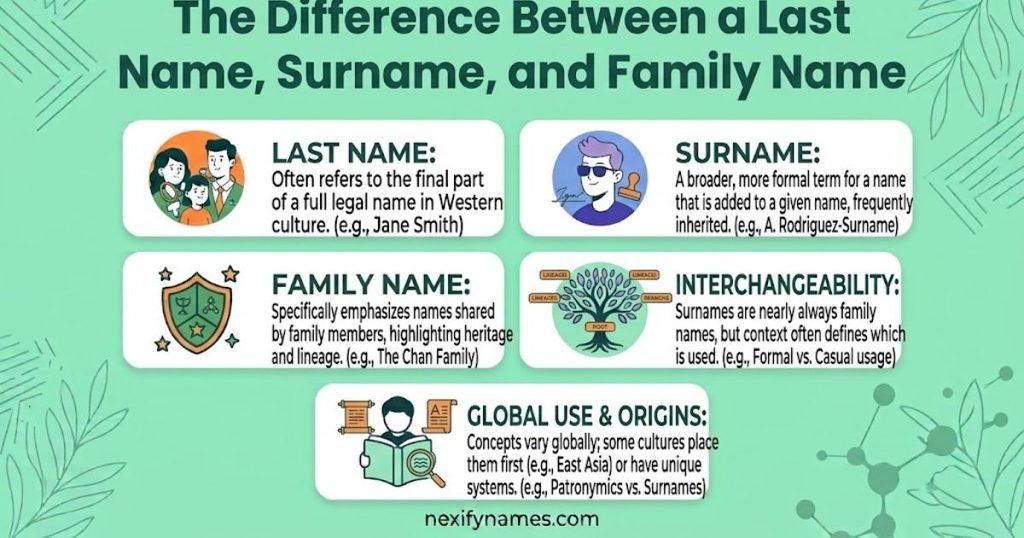
The Difference Between a Last Name, Surname, and Family Name
In everyday English, last name, surname, and family name usually refer to the same part of a person’s name. The terms describe a name associated with family identity, although naming order differs across cultures. In some countries, the family name appears before the given name.
Not every naming system fits the traditional Western first-name-and-last-name pattern. Some people use multiple surnames, while others follow naming traditions that don’t rely on hereditary family names in the same way. When completing official forms, follow the instructions for the relevant country or organization.
Examples:
- Last name: The term commonly used on US forms.
- Surname: A widely used formal term for a family name.
- Family name: A common term in international forms and official documents.
- Given name: The personal name assigned to someone, such as Emma or Daniel.
- Maiden name: A term traditionally used for a surname before marriage.
Why Some Cultures Use Two Last Names
Some cultures use two surnames to preserve family connections from both parents. In many Spanish-speaking naming traditions, a person may receive a paternal surname and a maternal surname. The exact order, legal rules, and practices vary between countries and families.
Two surnames can also appear through marriage, family preference, or hyphenation. For example, someone might retain both parents’ surnames or combine names after marriage. It’s best to check the relevant cultural and legal convention rather than assume everyone follows the same pattern.
How Last Names Have Changed Across Generations
Surnames can change as families move between countries, languages, and communities. Immigration officials, clerks, and family members sometimes recorded names differently, while some people deliberately adopted new spellings to make pronunciation or integration easier. Over time, these changes can create several versions of the same ancestral name.
Marriage, adoption, personal choice, and changes in legal naming rules can also affect family names. If you’re tracing your family tree, search for spelling variations and listen for similar pronunciations. A small difference in spelling doesn’t automatically mean two records refer to unrelated families.
- Mueller / Müller
- Schmidt / Schmitt
- Meyer / Meier
- Schneider / Snyder
- Johansson / Johanson
- MacDonald / McDonald
- De Luca / Deluca
- García / Garcia
- O’Connor / Oconnor
- Kowalski / Kowalsky
- Nowak / Novak
- Weiss / Weis
- Ivanov / Ivanoff
- Nguyen / Nguyễn
- Lee / Li
Why Do Some Families Spell the Same Surname Differently?
Different spellings can emerge through transliteration, regional pronunciation, clerical errors, or changes made after migration. Languages also use different alphabets and accent marks, which can produce several written forms of a name. Some variations are historically connected, while others only look similar.
When researching a family, compare dates, locations, relatives, and original documents rather than relying on spelling alone. Passenger lists, census records, and birth certificates may help connect variants. A reliable conclusion usually comes from several matching details, not one surname.
Frequently Asked Questions About Last Names
1. What are the most common last names in the United States?
Smith, Johnson, Williams, Brown, and Jones are among America’s most common last names, according to widely recognized surname rankings.
2. What are some cool last names for fictional characters?
Archer, Sterling, Ravenwood, Knox, and Hawthorne are memorable options for fictional characters, depending on their personalities and backgrounds.
3. How can I find the meaning of my last name?
Research your surname using genealogy databases, historical documents, family records, and reputable surname dictionaries to identify possible origins and meanings.
4. What is the difference between a surname and a family name?
Surname and family name generally mean the same thing, although naming order and conventions differ across cultures, countries, and families.
5. Which last names have royal origins?
Windsor, Tudor, Romanov, Bourbon, and Habsburg are associated with historical ruling dynasties, though sharing similar names doesn’t establish royal ancestry.
6. Why do some people have two last names?
Some cultures pass down surnames from both parents, preserving maternal and paternal family connections according to local naming traditions and legal customs.
7. Can I invent a last name for a fictional character?
Yes, you can create original surnames for fictional characters. Consider pronunciation, cultural context, personality, and consistency when developing a believable name.
Final Thoughts on Last Names
A last name is more than just a name—it’s a small piece of history that can carry generations of stories, traditions, and meaning. From common last names like Smith and Johnson to rare, elegant, and powerful surnames, every name has something that makes it special. Some reflect family heritage, others reveal cultural roots, and a few have the perfect ring for a memorable fictional character.
Whether you’re researching your ancestry, choosing a surname for a story, or simply searching for inspiration, this collection of last names gives you plenty of options to consider. Look beyond how a name sounds and discover the meaning, history, and personality behind it. You might find a surname that feels timeless, sparks your imagination, or connects you with your roots. After all, the right last name doesn’t just complete a name—it gives it character, identity, and a story worth telling.
Pingback: Cool Last Name Meanings: 250+ Unique, Powerful, and Mysterious Surnames