
Every culture has a trickster — the fox who outsmarts the wolf, the god who steals fire, the spider who talks his way out of trouble. Tricksters are clever, funny, and just a little dangerous, and their names carry all of that energy.
This list has 300 names that mean trickster, or come from trickster figures, in every style: gods and folk heroes, boys’ and girls’ names, fox names, Japanese names, surnames, and pet names. Some mean “cunning” or “deceit” in the most literal sense. Others belong to characters famous for their tricks.
One honest note first: this article separates those two kinds. Literal meanings are labeled with their real definitions. Story names are labeled with the story, not a made-up meaning. Nothing here claims a meaning it doesn’t have. If you like meaning-based names, our list of names that mean dragon is the closest sibling to this one.
Names That Literally Mean Trickster, Cunning, or Deceit
These are real words for trickery, cunning, and deceit from languages around the world. Some work well as names (Dolos, Kolohe, Maya); others are bold word-names best suited to characters — we’ve noted which is which. If you like stage tricksters too, our jester names list covers the court fools and comic performers.
- Dolos — Greek for “trick, bait, guile” — and the personified spirit of trickery in Greek myth. The closest thing to a name that literally means trickster.
- Dolus — Latin for “trick, guile, deceit.” The Roman counterpart of Dolos.
- Apate — Greek for “deceit.” The goddess of deceit in Greek myth.
- Fallacia — Latin for “deceit, trickery.”
- Callidus — Latin for “cunning, clever, skillful.”
- Callida — The feminine form of callidus — Latin for “cunning.”
- Astutus — Latin for “shrewd, cunning, crafty.”
- Astuta — The feminine form of astutus — Latin for “shrewd.”
- Vafer — Latin for “sly, cunning, crafty.”
- Vafra — The feminine form of vafer — Latin for “sly.”
- Subdolus — Latin for “sly, crafty, deceitful.”
- Subdola — The feminine form of subdolus — Latin for “sly.”
- Fallax — Latin for “deceitful, deceptive.”
- Mendax — Latin for “lying, untruthful.”
- Falsus — Latin for “false, untrue.”
- Fraus — Latin for “fraud, deceit” — and the Roman personification of fraud.
- Dolosus — Latin for “full of guile, deceitful.”
- Mendacium — Latin for “lie, falsehood.”
- Perfidia — Latin for “treachery, faithlessness.”
- Mirmah — Hebrew for “deceit, treachery.” A real biblical name — a Benjamite in 1 Chronicles 8:10.
- Pseudes — Greek for “false, lying.”
- Kryptos — Greek for “hidden, secret.” The root of “cryptic.”
- Chatur — Sanskrit and Hindi for “clever, smart.”
- Kapata — Sanskrit for “deceit, fraud.”
- Chhal — Hindi for “trickery, deceit.”
- Maya — Sanskrit for “illusion.” In Hindu philosophy, the veil that hides reality.
- Astucia — Spanish for “cunning, shrewdness.”
- Astuce — French for “a clever trick, a ruse.”
- Furbo — Italian for “cunning, sly, crafty.”
- Twyll — Welsh for “deceit, trickery.”
- Cealg — Irish for “deceit, guile.”
- Uso — Japanese for “lie.”
- Kolohe — Hawaiian for “mischievous, naughty, rascal.” A real word used as a name in Hawaii.
- Guile — English word for “cunning, crafty deceit.”
- Svik — Norwegian for “betrayal, treachery.”
- Hile — Turkish for “trick, deceit, ruse.”
- Makr — Arabic for “cunning, deceit, scheming.”
- Dajal — Arabic for “deceit, imposture.”
Trickster God Names
Nearly every mythology has a trickster god — the figure who breaks rules, steals fire, outwits monsters, and sometimes saves the world by accident. These are the figures behind the stories, from Loki in the north to Anansi in West Africa. For more divine figures, explore our goddess names list.
Greek Trickster Names
Greek myth is full of tricksters — gods, heroes, and kings who win by wit rather than strength. Hermes stole Apollo’s cattle on the day he was born. Odysseus won a war with a wooden horse. Sisyphus cheated death twice.
- Hermes — Greek god of thieves, travelers, and merchants — and a master thief from birth.
- Prometheus — The Titan who tricked Zeus and stole fire for humans.
- Odysseus — Greek hero famed for cunning schemes, above all the Trojan Horse.
- Autolycus — Greek master thief, son of Hermes and grandfather of Odysseus.
- Sisyphus — Greek king who cheated death twice — and paid for it forever.
- Pan — Greek god of the wild, known for mischief and sudden panic.
- Momus — Greek god of mockery and blame.
- Eris — Greek goddess of strife and discord — her golden apple started the Trojan War.
- Ate — Greek goddess of ruin and reckless delusion.
- Proteus — Greek sea god who shapeshifted to dodge questions.
- Circe — Greek sorceress who turned Odysseus’s men into pigs.
- Sinon — The Greek who lied Troy into taking the wooden horse inside its walls.
Norse, Celtic & English Tricksters
The north has Loki, the most famous trickster god of all — but he is not alone. Celtic myth has its shapeshifters and schemers, and English folklore has Puck, the fairy who leads travelers astray.
- Loki — Norse trickster god, shapeshifter, and chaos-maker. His name’s meaning is debated by scholars — what is certain is his role.
- Utgard-Loki — A giant of Norse myth, distinct from Loki — “Loki of Utgard,” master of illusions.
- Odin — Not primarily a trickster god, but he constantly uses disguise, trickery, and stolen knowledge to get his way.
- Puck — Mischievous fairy of English folklore, also called Robin Goodfellow.
- Gwydion — Welsh magician who tricks his way through the Mabinogion.
- Morrigan — Irish goddess of war and fate, who shapeshifts and schemes.
- Lugh — Irish god and master of many skills, who outwits his opponents as often as he outfights them.
- Puca — Irish shapeshifter spirit, often a trickster.
Trickster Gods From Around the World
Every continent has its trickster. The spider Anansi brought stories to humanity. Coyote shaped the world and then tripped over his own schemes. The Monkey King defied heaven itself.
- Anansi — The Akan spider trickster, hero of West African and Caribbean stories.
- Coyote — Trickster and creator in many Native American traditions.
- Eshu — Yoruba trickster and messenger of the crossroads.
- Legba — Vodou crossroads spirit, often linked to Eshu.
- Nanabozho — Ojibwe trickster and culture hero.
- Wisakedjak — Cree trickster and culture hero.
- Gluskap — Wabanaki trickster hero.
- Iktomi — Lakota spider trickster, a shapeshifter and storyteller.
- Raven — Trickster and creator in many Pacific Northwest traditions.
- Kokopelli — Pueblo flute player, sometimes linked to mischief.
- Maui — Polynesian demigod famed for clever tricks and shapeshifting.
- Sun Wukong — The Chinese Monkey King, famed for trickery and rebellion.
- Krishna — Hindu god known for playful mischief — as a child, he stole butter from every house.
- Hanuman — Hindu monkey god with trickster traits.
- Nasreddin — Folk trickster and wise fool of Middle Eastern tales.
- Till Eulenspiegel — German folk prankster and jester.
- Saci — One-legged trickster spirit from Brazilian folklore.
- Karagöz — Trickster of Turkish shadow plays.
- Tezcatlipoca — Aztec god of sorcery, night, and shifting faces.
- Enki — Sumerian god of water, wisdom, and cunning.
- Veles — Slavic god of cattle, trickery, and the underworld.
- Maximon — Maya folk saint associated with trickery and vice.
- Heyoka — Lakota sacred clown and contrary — a trickster who does everything backwards.
- Wakdjunkaga — Trickster hero of the Winnebago (Ho-Chunk) people.
- Kalulu — Hare trickster in Bantu folktales.
- Brer Rabbit — Trickster rabbit of African American folk tales.
Girl Names That Mean Trickster
Few girl names literally mean trickster — most languages don’t have a feminine given name with that meaning. The one real exception is Medea, Greek for “cunning.” The rest of this section mixes mythological schemers, literary tricksters, and word-names, each labeled honestly. For more moon-inspired ideas, see our names that mean moon list.
- Medea — Greek, “cunning” (from mēdea, “plans, counsel, cunning”). The Colchian sorceress who helped Jason win the Golden Fleece — and took a terrible revenge when he left her. Heavy story; use with eyes open.
- Calypso — Greek for “she who hides.” The nymph who kept Odysseus on her island for seven years.
- Morgana — Arthurian sorceress famed for illusion and scheming. Also spelled Morgan le Fay.
- Pandora — Greek for “all gifts.” Her jar hid every evil — a gift that concealed harm.
- Nyx — Greek goddess of night. Darkness suits a trickster’s work.
- Lilith — Figure in Jewish folklore, often cast as a night spirit who defies the rules.
- Baba Yaga — The witch of Slavic folklore, who tricks and tests the heroes who visit her hut.
- Lorelei — Rhine siren who lured sailors with her song. A lure, not a liar — but the deception is the point.
- Delilah — Biblical woman who betrayed Samson by learning the secret of his strength.
- Jezebel — Biblical queen whose name became a byword for scheming and treachery. Heavy baggage — best for characters, not babies.
- Sapphira — Biblical woman who lied about money alongside her husband Ananias.
- Manthara — The maid in the Ramayana who schemed a queen into exiling Rama.
- Agrippina — Roman empress known for ruthless political scheming.
- Livia — Roman empress long rumored to scheme in secret.
- Peitho — Greek goddess of persuasion. Tricksters win with words first.
- Suada — Roman goddess of persuasion, Peitho’s counterpart.
- Trixie — A diminutive of Beatrice (“she who brings happiness”) — it only sounds like “tricks.” The sound is the whole joke.
- Aella — Greek for “whirlwind.” An Amazon name; the chaos is the connection, not a trickster meaning.
- Tempest — English for a storm. Chaos, noise, and trouble in one word.
- Rebel — English for one who defies authority. Tricksters break rules by nature.
- Salome — Biblical dancer whose request led to John the Baptist’s death. A schemer’s name with heavy baggage.
- Hecate — Greek goddess of magic, crossroads, and the night. Crossroads are the trickster’s home ground.
- Lamia — Greek monster who lured children. A dark, luring figure — best for characters.
- Scheherazade — The storyteller of One Thousand and One Nights, who talked her way out of death with 1,001 stories. The greatest verbal trick in literature.
- Penelope — Greek; its etymology is uncertain, but she outwitted her suitors for years by weaving and unweaving her tapestry. The trick is the story, not the meaning.
Boy Names That Mean Trickster
The boys’ list runs from the Bible to the stage. Jacob is the Bible’s great trickster patriarch. The theatre gives us the scheming servants — Scapin, Figaro, Harlequin — who lie their masters out of trouble. For more powerful meaning-names, see our names that mean lightning list.
- Jacob — Hebrew for “supplanter.” He tricked Esau out of his birthright and his blessing — the Bible’s great trickster patriarch.
- Ananias — Biblical man who lied to the apostles about money, alongside his wife Sapphira.
- Gehazi — Elisha’s servant, who lied to profit from a healing.
- Iago — Shakespeare’s villain in Othello, the most famous schemer in English drama.
- Judas — The disciple who betrayed Jesus. Heavy baggage — a character name, not a baby name.
- Machiavelli — Renaissance writer whose name now means cunning politics.
- Casanova — The real 18th-century adventurer, famed as a charmer who talked his way everywhere.
- Figaro — The clever barber of Beaumarchais and Rossini, who outwits his betters.
- Scapin — Molière’s scheming servant, who lies his masters out of trouble.
- Pseudolus — The scheming slave of Plautus’s comedy; from Greek pseudes, “false.”
- Panurge — Rabelais’s witty rogue, always one scheme ahead.
- Mosca — Italian for “fly.” Volpone’s sly accomplice in Ben Jonson’s play.
- Truffaldino — The Italian stage servant who juggles two masters and twice the lies.
- Brighella — The commedia dell’arte con man and scheming servant.
- Mascarille — Molière’s trickster valet.
- Subtle — The con-man alchemist of Ben Jonson’s play The Alchemist.
- Harlequin — The comic trickster servant of Italian commedia dell’arte, in his diamond-patterned costume.
- Arlecchino — The Italian form of Harlequin.
- Pulcinella — The hunchbacked clown-trickster of commedia dell’arte and puppet theatre.
- Chanakya — Indian strategist and author of the Arthashastra, famed for shrewd statecraft.
- Merlin — The wizard of Arthurian legend, who works through disguise, prophecy, and misdirection.
- Rumpelstiltskin — The imp of the fairy tale, whose tricky bargains turn on a name.
- Aladdin — The “diamond in the rough” thief of the Arabian Nights tale.
- Fagin — Dickens’s fence in Oliver Twist, who trains boys to pick pockets.
- Artful Dodger — Dickens’s young pickpocket, the most famous child thief in literature.
Unisex Trickster Names
Word-names and figure names that work for anyone — masks, riddles, gambits, and rogues. If you like protective meanings too, our female names that mean protector list is a good companion.
- Robin — Short for Robin Goodfellow, another name for Puck.
- Mercury — Roman god of messengers, thieves, and merchants. Hermes’s Roman form.
- Jester — The court fool who speaks truth through jokes.
- Jinx — A curse or hex — and a name that sounds like trouble.
- Cipher — A code that hides meaning.
- Riddle — A puzzle with a hidden answer.
- Enigma — A mystery no one can quite solve.
- Gambit — An opening move that risks something to win.
- Ruse — A clever trick.
- Bluff — A false show of strength.
- Feint — A fake move meant to mislead.
- Masque — A mask; a disguise worn to a ball.
- Fable — A story that teaches through trickery — Aesop’s foxes and crows.
- Mischief — Playful misbehavior, in one word.
- Rogue — A charming scoundrel.
- Knave — A dishonest rogue; also the jack in a deck of cards.
- Rascal — A lovable troublemaker.
- Scamp — A playful rascal.
- Sly — Clever in a secretive way.
- Wily — Crafty and full of tricks.
- Mirage — A false image in the desert. Nothing is what it seems.
- Magpie — The bird with a reputation for theft.
- Jackal — A trickster animal in Middle Eastern and African tales.
- Cozen — An old verb meaning to deceive by trickery.
- Trickster — The word itself, worn as a name. Bold — best for characters and pets.
Names That Mean Cunning, Sly, or Clever
Cunning isn’t always cruel. Sometimes it just means sharp — quick thinking, good judgment, and the ability to see three moves ahead. This section mixes real words for cleverness from Latin, Greek, Arabic, and Sanskrit with English word-names. For a nobler kind of strength, see our names that mean noble list.
- Sagax — Latin for “keen, sharp, shrewd.”
- Athena — Greek goddess of wisdom and clever strategy. Her cunning is the thoughtful kind.
- Minerva — Athena’s Roman counterpart — wisdom, craft, and strategy.
- Thoth — Egyptian god of wisdom and writing. Not a trickster god, but the cleverest mind in his pantheon.
- Sophia — Greek for “wisdom.” Cleverness without the cruelty.
- Akil — Arabic for “intelligent, rational.”
- Zaki — Arabic for “intelligent, clever.”
- Fahim — Arabic for “understanding, intelligent.”
- Hakeem — Arabic for “wise.”
- Alim — Arabic for “learned, knowledgeable.”
- Pragya — Sanskrit for “wisdom, insight.”
- Medha — Sanskrit for “wisdom, intellect.”
- Cameron — Scottish, “crooked nose” (cam “crooked” + sròn “nose”). The “crooked” is why it lands on trickster lists — honestly, it’s the bend, not the trick.
- Clever — The word itself: quick-witted and sharp.
- Cunning — Skilled in deception; the classic trickster adjective.
- Crafty — Clever at getting what you want, by fair means or foul.
- Shrewd — Sharp in judgment, with an eye for advantage.
- Keen — Sharp, quick, and eager.
- Astute — Shrewd and perceptive.
- Foxy — Clever like a fox — though it also means attractive, so the joke cuts two ways.
- Slick — Smooth, clever, and a little slippery.
- Glib — Fluent and persuasive — sometimes too persuasive.
- Artful — Clever, skillful — and, in its older sense, full of artifice.
- Wry — Dry, twisted humor. A wry smile hides a trick.
- Devious — Clever in an underhanded way.
Fox-Inspired Trickster Names
The fox is the trickster’s animal. Reynard outwits the wolf in medieval fables. Kitsune shapeshifts in Japan. Br’er Fox chases Br’er Rabbit through American folk tales. This section gathers the fox’s names — and the word for “fox” in languages around the world.
- Reynard — The fox of the medieval Roman de Renart. From Old High German Reginhart, “strong in counsel” — the name means wise counsel, but the character is the trickster fox himself.
- Renard — French for “fox” — the word came from Reynard’s name.
- Renart — The Old French form of Reynard’s name.
- Reineke — The German name of the same fox, from Reineke Fuchs.
- Reynardine — The fox of English ballad tradition.
- Br’er Fox — The fox of the Uncle Remus tales, forever chasing Br’er Rabbit.
- Tod — An old English and Scots word for a fox.
- Vixen — A female fox.
- Kit — A young fox.
- Fox — The animal itself, worn as a name.
- Vulpes — Latin for “fox.”
- Volpe — Italian for “fox.”
- Zorro — Spanish for “fox” — and a masked hero who outwits his enemies.
- Goupil — The old French word for fox, before Reynard’s name replaced it.
- Fuchs — German for “fox.”
- Räv — Swedish for “fox.”
- Rev — Norwegian and Danish for “fox.”
- Kettu — Finnish for “fox.”
- Róka — Hungarian for “fox.”
- Tilki — Turkish for “fox.”
- Tha’lab — Arabic for “fox.”
- Lomdi — Hindi for “fox” (feminine form).
- Lis — Russian and Polish for “fox.”
- Huli — Chinese for “fox.”
- Yeou — Korean for “fox.”
- Vulpine — English adjective meaning “fox-like, cunning.”
Japanese Trickster Names
Japanese folklore holds some of the richest tricksters anywhere. The fox spirit Kitsune leads the pack, but the raccoon dog, the river imp, and the mountain goblin all play their own tricks. Most entries below are folklore terms, not common given names — use them for characters, pets, or usernames. Shapeshifters fit right in with our changeling names collection, and the site’s only Japanese-category post is our Japanese horse names list.
- Kitsune — The fox spirit of Japanese folklore — a shapeshifter and trickster.
- Tanuki — The raccoon dog spirit, a playful shapeshifter.
- Tengu — The mountain spirit known for mischief and trickery.
- Kappa — The river imp known for pranks.
- Nue — A chimera-like monster that changes shape.
- Bakeneko — The shapeshifting cat spirit.
- Nekomata — The two-tailed cat spirit.
- Jorōgumo — The spider woman who lures victims. A trickster’s lure, with a darker edge.
- Nurarihyon — The slippery yōkai who slips into homes as if he owned them.
- Kuzunoha — The fox wife of a famous Japanese legend.
- Tamamo — The nine-tailed fox of the Tamamo-no-Mae tale.
- Kitsu — A short form of kitsune.
- Inari — The kami of rice, whose fox messengers shape the kitsune legends.
- Kage — Japanese for “shadow.”
- Karasu — Japanese for “crow” — a clever, thieving bird.
- Yami — Japanese for “darkness.”
- Kurai — Japanese for “dark.”
- Itsuwari — Japanese for “falsehood, deception.”
- Shinobi — Japanese for a hidden spy — the ninja’s older name.
- Akuma — Japanese for “devil, demon.”
Trickster Names From Stories & Pop Culture
The tricksters everyone knows — from Bugs Bunny to Jack Sparrow to the twins who turned Hogwarts upside down. These are fictional characters, labeled as such, and they make great names for pets, usernames, and characters of your own. Rogues and schemers also sail through our witty pirate names list.
- Bugs Bunny — The rabbit who outsmarts everyone, in every cartoon.
- The Joker — DC’s agent of chaos, who turns every plan into a prank.
- Jack Sparrow — The pirate who lies, bargains, and talks his way out of everything.
- Flynn Rider — The charming thief of Disney’s Tangled.
- Peter Pan — The boy who never grows up — and never stops causing mischief.
- Cheshire Cat — The grinning cat of Alice in Wonderland, who vanishes and leaves only a smile.
- Harley Quinn — DC’s chaotic trickster, once the Joker’s partner.
- The Riddler — Batman’s villain, who turns every crime into a puzzle.
- Q — The mischievous near-omnipotent being of Star Trek.
- Deadpool — Marvel’s antihero, who breaks the fourth wall and every rule.
- Catwoman — The thief of Gotham, agile, clever, and always one step ahead.
- Wile E. Coyote — The cartoon coyote whose elaborate schemes always backfire.
- Calvin — The boy of Calvin and Hobbes, whose imagination powers endless pranks.
- Beetlejuice — The ghost with the most — chaotic, tricky, and hard to get rid of.
- Genie — The magical trickster of Aladdin, whose wishes always have a twist.
- Kuzco — The emperor of The Emperor’s New Groove, schemer turned hero.
- Rocket Raccoon — The Guardians of the Galaxy raccoon, a thief and a tinkerer.
- Discord — The draconequus of My Little Pony, spirit of chaos and disharmony.
- Han Solo — The smuggler of Star Wars, who bluffs his way through the galaxy.
- Tyrion Lannister — Game of Thrones’ wittiest schemer, who wins with words.
- Peeves — The poltergeist of Hogwarts, who causes trouble for students and staff alike.
- Fred and George Weasley — The twin pranksters of Harry Potter. (One entry — a pair.)
- Bart Simpson — The prankster of Springfield.
- Tom Sawyer — Mark Twain’s boy, who tricks his friends into whitewashing a fence.
- Puss in Boots — The clever cat of the fairy tale, who talks his master into a fortune.
- Robin Hood — The outlaw who steals from the rich with wit and disguise.
- Pinocchio — The puppet whose lies make his nose grow.
- Felix the Cat — The cartoon cat who talks his way out of trouble.
- Dobby — The house-elf of Harry Potter, whose mischievous help causes chaos.
- The Mask — The character whose magical mask unleashes chaotic tricks.
Last Names That Mean Trickster
Trickster surnames are real, everyday family names — mostly fox names (Fox, Todd, Fuchs, Volpe) and the Reynard family, since the fox is the trickster’s animal. Every name below is a documented surname, not an invention. For more surname ideas, see our fantasy last names collection and our dark names with meanings list.
- Raynard — A variant of Reynard — Germanic, “strong in counsel,” and the trickster fox’s name.
- Reynolds — From Reynold, the same Germanic root as Reynard — “counsel” and “rule.”
- Foxe — An old spelling of the surname Fox.
- Todd — From tod, the old English word for a fox.
- Vos — Dutch surname meaning “fox.”
- Lisowski — Polish surname from lis, “fox.”
- Volpi — Italian surname from volpe, “fox.”
- Raposo — Portuguese and Spanish surname meaning “fox.”
- Voss — Low German surname meaning “fox.”
- Kettunen — Finnish surname from kettu, “fox.”
- Slye — A variant of the surname Sly.
- Wylie — Scottish surname, often linked to Old English wilig, “crafty” — though some sources trace it to a place name.
- Wiley — A variant of Wylie, with the same debated origin.
- Trickett — An English surname, possibly from a medieval word for a trick. The derivation is uncertain — treat it as a maybe.
- Crook — From Old Norse krókr, “bend, crook.” In modern English, a crook is a criminal — the double meaning is the joke.
- Rook — A real surname — and a verb meaning to cheat someone.
- Foxworth — An English surname combining fox with an enclosure.
- Foxwell — An English surname combining fox with a spring or stream.
- Todhunter — An English surname meaning “fox hunter.”
- Volpone — Italian surname from volpe, “fox” — and the fox-like con man of Ben Jonson’s play.
Trickster Names for Pets
A pet can carry a name no baby should. These are playful, mischievous, and easy to call across a park — thieves, escape artists, and chaos agents. If you like the playful side of naming, our funny names like Ben Dover list is in the same spirit.
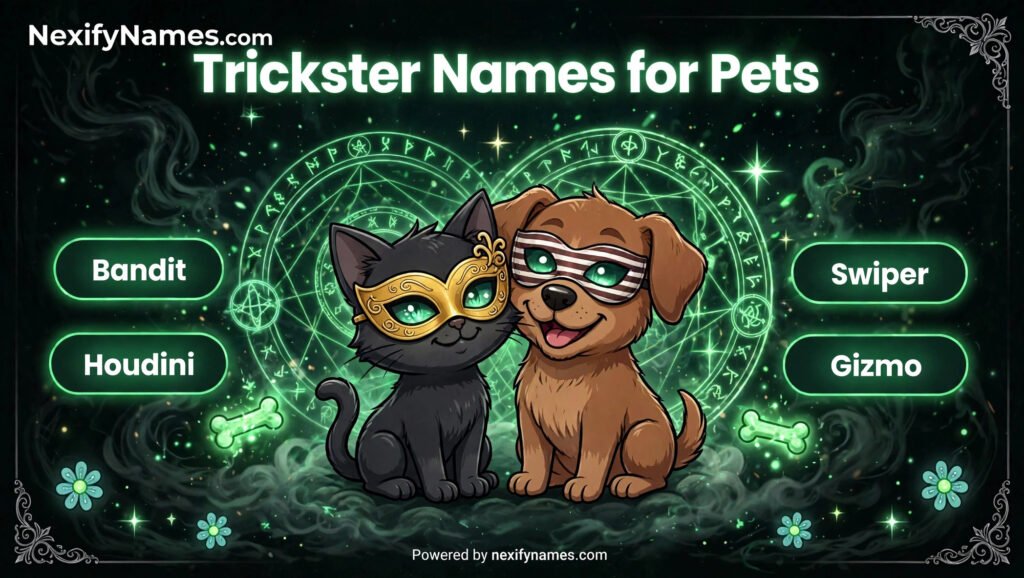
- Bandit — A thief’s name, perfect for a pet who steals socks.
- Sneaky — For the pet who moves like a shadow.
- Swiper — Dora’s fox, who swipes everything in sight.
- Meeko — The thieving raccoon of Disney’s Pocahontas.
- Nick Wilde — The fox con artist of Zootopia.
- Gizmo — The Gremlins’ cute creature — and the chaos that follows him.
- Stitch — Lilo & Stitch’s alien, a one-creature chaos machine.
- Houdini — The escape artist — for the pet who opens every door.
- Trouble — A warning and a name in one.
- Chaos — For the pet who rearranges your house daily.
- Mayhem — Chaos’s louder cousin.
- Pickpocket — For the cat who lifts treats from your plate.
- Slinky — Smooth, sneaky, and always sliding past you.
- Zippy — Fast, quick, and gone before you notice.
- Dash — Quick as a wink.
- Ziggy — A zigzag name for a pet who never walks straight.
- Trick — The word itself — short, sharp, and easy to call.
- Prank — For the pet who lives to surprise you.
- Jape — An old word for a trick or a joke.
- Hoax — For the pet who fakes you out — the empty food bowl trick.
How to Choose a Trickster Name
Start with the kind of name you want. If the meaning matters most, pick from the literal translations — Dolos, Kolohe, and Maya are the most wearable. If the story matters most, the mythological names (Loki, Anansi, Coyote) carry the richest associations. If you want something dark and dramatic, the darker trickster figures and our demon names list are the strongest choices.
Then check the practical side. Can people pronounce it? Can they spell it after hearing it once? A name like Nurarihyon is a wonderful curiosity, but it will be misspelled forever. A name like Puck or Kolohe is unusual without being difficult. Say the full name out loud with the last name — if it trips your tongue, try another. For darker surname pairings, our dark last names list has options in the same vein.
Finally, think about who will carry the name — and check the baggage. A baby needs a name that works at school and at work. A character can carry something stranger. A pet can be called anything — Bandit is a magnificent name for a cat. And some names carry heavy stories: Judas, Jezebel, and Delilah are powerful character names, but they are a lot to hand a real child. Match the boldness of the name to the life it will live. For a softer corner of the same “mean” cluster, our names that mean pink list is a gentle contrast.
FAQs About Names That Mean Trickster
What name literally means trickster?
No common given name literally translates to “trickster.” The closest literal meanings are Dolos (Greek, trickery), Mirmah (Hebrew, deceit), and Kolohe (Hawaiian, mischievous).
What is the best trickster name for a boy?
Jacob (“supplanter”), Loki, and Puck are the strongest boy choices — all three come with famous trickster stories and are easy to say.
What girl names mean trickster?
Medea is the standout: Greek for “cunning.” Calypso (“she who hides”), Morgana, and Pandora are strong story-linked choices too.
What is the Viking name for trickster?
Loki is the Norse trickster god. His name’s meaning is debated by scholars, but his role as the gods’ trickster is certain.
What Bible name means trickster?
Jacob, Hebrew for “supplanter,” tricked his brother Esau out of his birthright and blessing. Mirmah literally means “deceit.”
Are trickster names good for babies?
Yes, if you pick the playful ones — Loki, Puck, Medea, Kolohe. Avoid heavy names like Judas or Jezebel for a real child.
What is a Japanese trickster name?
Kitsune, the shapeshifting fox spirit, is the classic choice. Tanuki, Tengu, and Kappa are playful yōkai alternatives.
Conclusion
A trickster name can be literal, mythological, or inspired — and the best one depends on what you want it to do. Dolos and Mirmah are honest literal choices. Loki and Anansi carry stories thousands of years old. Reynard and Kitsune are foxes with a trickster’s soul.
Pick the name that feels right when you say it out loud, check that the meaning is real (not invented), and match the boldness to the bearer — a baby needs a name that works at school, while a character or a pet can carry something stranger. If you want the full story behind the most famous trickster of all, Britannica’s article on Loki is the best place to start.
Tricksters remind us that cleverness beats strength, and that a good story is worth more than a straight answer. Whatever name you choose, may its bearer be quick, curious, and just mischievous enough.